

33. Balanced on a Bird-Spire
One second after you clamber onto the topmost rock, the flock thunders through the air around you.
A murmuration of starlings, black and featureless against a last light that still pierces the far horizon with silver-blue precision.
Your clothes whip against your body.
[ Stand unperturbed no matter how precarious this ledge ] —
The mass is deafening from inside. Ten-thousand triangular wingbeats, shrill shrieks criss-crossing the chaos like paint strokes flung from a spinning porcupine.
They pass into silence.
You look for the lone bird that breaks formation.
A single wave undulates across the inky dusk, now nearly invisible.
// Side B //
Thank you for tuning in ~ you just heard a piano interlude improvised live at TAIMOM Festival Day 3. Our trio that crisp autumn eve: Lucia Boffo (vocals, kicking off the clip) and Quique Sinesi (guitar, launching into spirited solo past the end).
It was a delight and honor to play with these legendary larks, and now that the audio from all festival nights is mixed-and-mastered1 we’ll be rolling out more music tout suite.
I continue to be enchanted by open improvisation — synonymous with free, but I find open exciting because it implies invitation and care for listener experience. Video of the solo-piano-above forges ahead into two breathtaking journeys led by Lucia (6:00) and Quique (10:25) ~
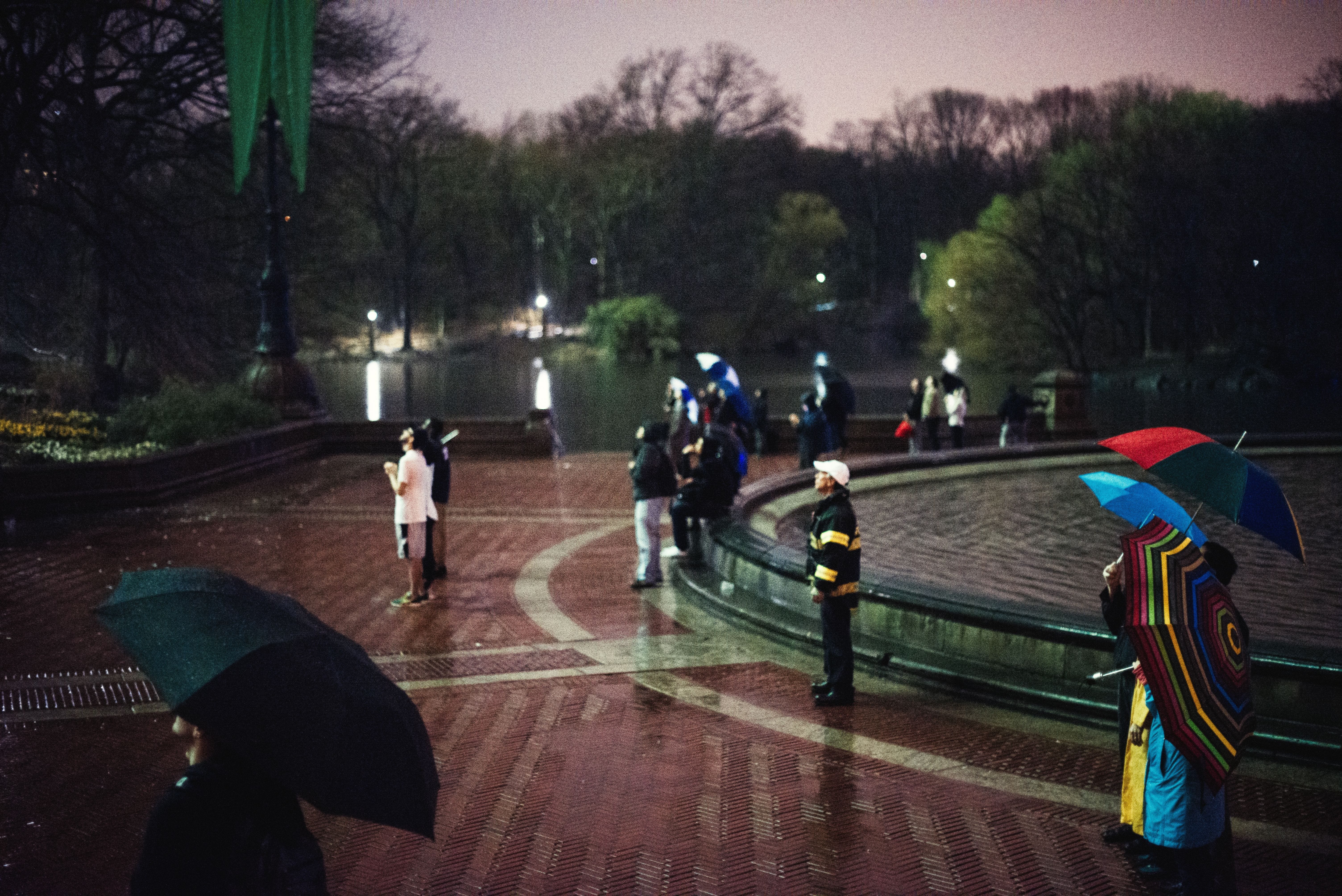
And we closed out with a photo from Central Park, NYC. Spectators marveling at fireworks transformed into statues of wonder and I couldn’t resist taking pictures of them, too.
☔️
Rhythm is Freedom
This essay is about two women who set me free.
𐡸 1 𐡷
I’ve written about my 101-year-old grandma before, but seeing her again this spring sparked an Astonishing Experience.
By a local train station on the outskirts of Taipei we’ve just gone for a stroll, Grandma and I, peeking at a nearby pond from a small, elevated, outdoor stage where she dances (!) each morning as a pause from her routine walks.
Now we’re seated in the living room at my aunt and uncle’s house — she’s got her plush armchair with table pushed up as food tray, I’ve got my stool made out of plastic green tortoise — snacking on pineapple cakes and watermelon seeds (salted, cracked open with one’s canine teeth, echoes of pistachio).
I ask her a million questions.
Where were you when ___?
What routines did you make?
In what ways have you been a rebel?
Did you fall in love?
Favorite vacation?
Scariest performance? (as lifelong choreographer + teacher)
Best friends, what were they like?
Big celebrations? First time you got drunk? Most meaningful gift?
What you witnessed that changed your life?
Grandma’s game for it all. We’re rolling with laughter — even at the horrifying stuff: Japanese occupation of Taiwan, martial law, absurd domestic disputes erupting in violence — it’s hard not to, with her penchant for mirth, impeccable vibes, and the clarity of someone who’s DJ’ed over 100 spins.
With the calibrated air of someone who’s been onstage her whole life — to showcase, sign books, receive awards, or (as she’s increasingly asked) give a speech on “how should one live?” her tone has nonetheless shifted.
Last visit, she spoke at length on love, gratitude, patience.
Nowadays her motto is simple: Create, courageously.
“You must be inventive, you must have courage” — plus a stronger summary where the Mandarin translates literally to: “You cannot not-dare.”2
Daring is the ticket.
(Did she say it all this time, and I’m only now ready to listen?)
𐡸 2 𐡷
Twelve years ago, I’m the one dancing. There’s no music in the room — just me stomping and slapping my legs in confusion while seated at a piano bench in an otherwise peaceful apartment overlooking East 83rd Street.
Sophia Rosoff watches — ensconced in her armchair planted next to me, her living space the vibrant, secret sanctuary of a reading room — silently conducting a Bach Fugue in C major she knows cold . . . as I stop-and-start, trying to express its four voices, embodied, my four limbs sputtering to each do their own thing without swaying the others.
We move on to bebop. When I solo over Bud Powell’s “Oblivion”, molto trepidante marks the initial chorus, because I’m still traumatized by teachers with classical-music backgrounds failing to attune to either rhythm or improvisation.
Sophia transcends it all with piercing insight. As though the notes are unimportant save for the heartbeat they illuminate. “You let me synchronize with you towards the end.” And a forever-gift: “You play beautifully.”
Our lesson closes with Chopin’s first etude from Opus 10. We anchor the song’s rhythmic core by “outlining” it: playing only the first note of each measure over the first page, then two notes — the first note plus the anticipatory note before it — then three . . . and so on. The exercise is perfect for this piece, whose arpeggios require acrobatics, where dance is engraved into its very syntax. Within minutes, the understudy comprehends its motion, its emotion, its why we’re gathered here.
Music lives in the body, through the body, no exceptions.
This eureka moment, unclasped by Sophia like the opening swivel of a window latch replete with satisfying unclick, redefined how I approach performance and pedagogy, and restored confidence in my own playing too.
To me its truth is fire, a reminder that everything was always in its right place. Rhythm supreme. Feel is not icing on the cake. It is everything.
And oral tradition is our soil. Body to body.
“I don’t teach,” says Rosoff. “I explore. I clear the tracks so the feeling the student has for the music can emerge.”
Reading these words recently — written by Sarah Deming in 2011 and reposted by Ethan Iverson this April — transported me at once to Sophia’s effervescence, her openness and wit, her library of wonder. I’m new to Sarah’s writing and powers of observation, but the essay’s a must-dive for its poise (poet + philosopher + field-researcher) and cosmic implications: the billowing ripples of Sophia’s worldview, amplified through continuous forward transmission, the metaphysics of a sustain pedal held without end.
𐡸 3 𐡷
You are the drum // the drum is the body.
But the body is fragile.
Do you believe, as I do, that life is defiance against entropy?
That knowledge passed from person to person is vulnerable to loss, but by the same token irreplaceable — near-invincible against reduction3, codification, confiscation?
Grandma had me in her care until I was four. Then: a chaotic childhood, a re-rooting in rhythm as an adult, and a true reckoning with her only now. Which means the lessons were laid down before I could access them. Sophia cleared the obstacles; Grandma’s sparkling reservoir lay underneath. The ways I teach and play — exuberance + exploration — I’d taken for my own inventions, until I found they’d been her approach all along . . . and she dared it far further than I ever have, at a cost I’ll never need to pay.
As a duo they sound like this:
Do not resist your compass. The stuff wants to come out. We, the elders and our ancestors, will help you facilitate the cycle. (Gifts evaporate if hoarded, so gift away.)
As daughter of two wandering Hakka, Grandma arranged traditional Taiwanese folk songs into dances. Especially in the case of Hakka mountain songs —essentially work songs, sung during tea picking, passed mouth to mouth, never written down — each utterance encodes defiance, daring, freedom.
Dance completes the liberation.
Grandma smuggled it through occupation and erasure, Sophia past the conservatory and the printed note. Contraband made invisible, immune to seizure. What they’ve safeguarded is freedom itself, for us to steward and pass along.
Rhythm is Fire in Time
With Alexandre Cellier in Lutry, Switzerland: never saw someone play an espresso cup like that . . .
Flame’s in our hands now.
Polyrhythmic piano was meant to dance — and the pianos themselves have been waiting for the invitation4.
We started shooting the Wild Piano documentary in February, in Taipei5 — and here’s a debut clip: